
How to Know Whether Your Boiler Needs a Repair or a Full Replacement
When your boiler stops working properly in the middle of a Long Island winter, the first question is usually the most stressful one: can this be fixed, or do I need a whole new system?
The answer depends on several factors, including the age of the boiler, the nature of the problem, how much repairs have cost you over the past few years, and the efficiency of the unit compared to what is available today. As a company that has been replacing and servicing boilers across Nassau and Suffolk County since 1979, we have seen just about every scenario. This guide reflects what we tell homeowners when they call us for an honest assessment.
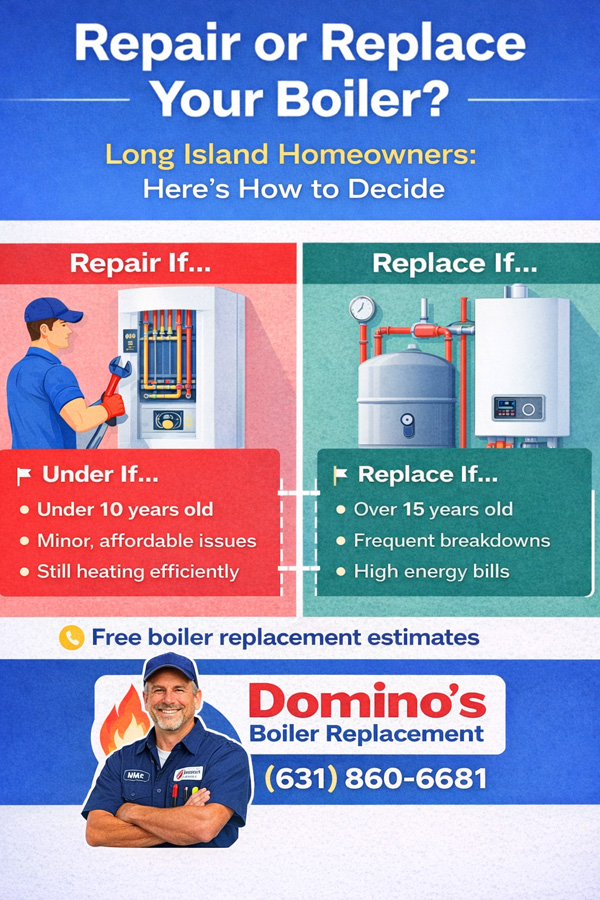
The 50% Rule: A Straightforward Starting Point
There is a widely used guideline in the HVAC industry known as the 50% rule. If a single repair will cost more than 50% of what a new boiler installation would run, replacement is almost always the better investment. This holds especially true if the boiler is past the midpoint of its expected lifespan.
For example, if you have a 20-year-old cast iron boiler and you are looking at a $3,500 repair for a cracked section, and a new high-efficiency gas boiler installed costs $7,990 to $11,000, the math starts to favor replacement. You would be putting significant money into a system that is likely to develop additional problems within the next few years.
Repair vs. Replace: Side-by-Side Comparison
| Factor | Lean Toward Repair | Lean Toward Replace |
|---|---|---|
| Boiler Age | Under 12 years | 15+ years (gas) / 20+ years (oil) |
| Repair Cost | Under $1,500 | Over $2,500 or 50%+ of new unit |
| Repair Frequency | First issue in years | 2+ service calls per season |
| Efficiency (AFUE) | 82%+ and still performing | Below 80% (new units reach 95-98%) |
| Parts Availability | Parts readily in stock | Discontinued or special order |
| Heating Bills | Stable year over year | Rising significantly each winter |
| Safety | No safety concerns flagged | CO detected, cracks, or failed heat exchanger |
| Comfort | Even heat, no cold spots | Uneven heating, banging, frequent cycling |
10 Warning Signs Your Boiler Is Ready for Replacement
Some symptoms point clearly toward replacement rather than another repair. If you are experiencing more than two or three of these at the same time, replacement is very likely the more cost-effective path.
Age Over 15 Years (Gas) or 20+ Years (Oil/Cast Iron)
Even well-maintained boilers lose efficiency and reliability past these thresholds. Replacement parts become harder to source and more expensive.
Rising Heating Bills Without Explanation
If your gas or oil bills have been climbing but your usage patterns have not changed, the boiler is likely losing efficiency. A new condensing unit can cut fuel costs by 20-35%.
Frequent Breakdowns (2+ Per Heating Season)
A boiler that needs service twice in one winter is telling you something. Each individual repair might seem manageable, but the cumulative cost adds up fast.
Yellow or Flickering Burner Flame
A healthy gas boiler produces a blue flame. Yellow or orange flames indicate incomplete combustion, which can produce carbon monoxide. This is a safety issue that should be addressed immediately.
Water Leaks Around the Boiler
Small leaks can sometimes be repaired, but corrosion-related leaks from the boiler body or heat exchanger usually signal the end. Water damage to your basement adds to the urgency.
Strange Noises: Banging, Kettling, or Clunking
Banging in steam systems can indicate waterlogged pipes or a failing header. Kettling (a rumbling sound) in hot water boilers usually means limescale buildup on the heat exchanger.
Uneven Heating Throughout the House
Rooms that used to stay warm but now run cold, or radiators that take much longer to heat up, suggest the boiler can no longer produce or distribute adequate heat.
Carbon Monoxide Detector Alerts
Any CO detection linked to your boiler is a red flag that should never be ignored. A cracked heat exchanger or failed flue can cause dangerous CO leaks. Shut the system down and call a professional right away.
Soot or Black Marks Near the Boiler
Soot deposits on or around the boiler indicate combustion problems. In oil boilers, this often means the burner assembly needs replacement, and in older units the cost may not be justified.
Manufacturer Has Discontinued Your Model
When your specific boiler model is no longer in production and replacement parts require special ordering with long lead times, every future repair becomes more expensive and time-consuming.
Boiler Parts That Commonly Fail (And What They Cost)
Understanding which components tend to break down helps put repair quotes into perspective. Below are the most common boiler parts that fail on Long Island residential systems, along with typical repair costs including labor.
Heat Exchanger
The core of your boiler. Cracks allow combustion gases to mix with heating water, creating CO risk. Cracked sections in cast iron boilers may be replaceable individually, but damage to multiple sections usually means full replacement.
Repair: $1,500 - $4,000+Circulator Pump
Moves hot water through your baseboard or radiator system. When it fails, you will notice certain zones not heating or the boiler short-cycling. Common in hot water boiler systems across Long Island.
Repair: $400 - $900Expansion Tank
Absorbs pressure changes as water heats and cools. A waterlogged or failed expansion tank causes the pressure relief valve to discharge. You may notice water on the floor near the boiler.
Repair: $250 - $600Pressure Relief Valve
A safety device that opens when system pressure exceeds safe limits. Frequent leaking or releasing may indicate a deeper problem with the expansion tank or system pressure.
Repair: $200 - $450Gas Valve / Oil Burner Assembly
The gas valve controls fuel flow in gas boilers. The oil burner assembly (nozzle, electrodes, pump) does the same for oil systems. Failure means no heat at all.
Repair: $350 - $1,200Ignition System (Pilot / Electronic)
Older boilers use standing pilot lights that can go out. Modern boilers use electronic ignition (hot surface or spark igniter). Electronic ignition failures are common and relatively affordable to fix.
Repair: $200 - $500Aquastat / Temperature Control
Controls water temperature in the boiler and tells the burner when to fire. A failing aquastat causes erratic heating, constant cycling, or no heat. Often misdiagnosed but straightforward to replace.
Repair: $250 - $650Zone Valves
Control which heating zones get hot water. Common in Long Island homes with multiple heating zones. When a zone valve sticks open or closed, certain areas will not heat properly or will overheat.
Repair: $300 - $700 per valveBackflow Preventer / Fill Valve
Maintains correct system pressure by allowing fresh water into the system when pressure drops. When it fails, you will notice low pressure readings and may need to manually add water frequently.
Repair: $200 - $500Flue / Chimney Liner
Vents combustion gases safely outside. Deteriorated chimney liners are a common issue in older Long Island homes. A damaged liner can cause backdrafting and CO risk. Relining is required when upgrading to certain high-efficiency systems.
Repair: $800 - $2,500When the combined cost of two or three of these repairs approaches 50% of a new installation, it is time for a serious conversation about replacement. We are always honest about which direction makes more financial sense for your specific situation.
What a New Boiler Replacement Costs on Long Island
Typical Replacement Cost Ranges (Installed)
Prices include equipment, labor, permits, and standard installation. Complex jobs (chimney reline, asbestos abatement, piping modifications) may add to the total. We provide detailed written estimates before any work begins.
For a detailed breakdown by system type, visit our complete cost guide.
The Decision Framework We Use With Every Customer
When you call us for an assessment, we walk through a structured evaluation. Here is exactly what we look at before making any recommendation.
Our 5-Point Assessment Process
Check the Age and Service History
We look at how old the boiler is, how often it has been serviced, and whether there is a pattern of recurring issues. A well-maintained 12-year-old boiler with its first problem is very different from a neglected 18-year-old unit.
Diagnose the Current Problem
We identify the exact component that has failed and determine the repair cost. Some issues, like a failed circulator pump or zone valve, are straightforward and cost-effective to fix. Others, like a cracked heat exchanger, change the equation entirely.
Evaluate Overall System Condition
Beyond the immediate failure, we inspect the general condition of the boiler, piping, and controls. Are there signs of corrosion, multiple past repairs, or marginal components that are likely to fail next?
Calculate the Real Cost of Each Option
We compare the repair cost against replacement, factoring in the remaining useful life, energy savings from a new high-efficiency system, and available rebates from National Grid or PSEG Long Island.
Give an Honest Recommendation
We tell you what we would do if it were our own home. If a $500 repair buys you 5 more reliable years, we will say so. If throwing $2,000 at a dying system is a waste, we will be upfront about that too.
When Repair Is the Right Call
Replacement is not always the answer. If your boiler is under 10-12 years old and experiencing its first mechanical issue, repair almost always wins. A single component failure in an otherwise healthy system does not justify a $7,990 to $11,000 replacement. The same applies when the repair involves a relatively inexpensive part like a circulator pump, expansion tank, or zone valve, and the boiler has been performing well otherwise.
Boilers that have been well maintained with annual servicing tend to reward continued repair. Regular maintenance prevents the kind of cascading failures that make older systems unreliable. If your service records show consistent annual tune-ups and the occasional minor repair, your boiler likely has years of life left in it.
Budget considerations matter too. If replacement is not financially feasible right now, a targeted repair can keep you warm while you plan and budget for a new system. We never push replacement when repair is a reasonable option.
When Replacement Is the Clear Winner
There are scenarios where continuing to repair is simply throwing good money after bad. If the boiler is past its expected lifespan and requiring multiple repairs per heating season, each service call chips away at money that could go toward a new, reliable, warrantied system. The cumulative cost of two or three annual repairs often exceeds the monthly cost of financing a new boiler.
Safety concerns always tip the scale toward replacement. A cracked heat exchanger, CO detection, or persistent combustion issues are not things to gamble with. Your family's safety is not negotiable.
Efficiency gains alone can justify replacement in many cases. If your current boiler operates at 78-82% AFUE and a new condensing boiler runs at 95-98% AFUE, you could save 20-35% on annual fuel costs. Over 15-20 years, those savings often offset most or all of the replacement cost.
What Happens During a Boiler Replacement
We start with a free in-home assessment where we evaluate your current system, measure your home's heating requirements, and discuss your priorities (budget, efficiency, fuel type, hot water needs). We then provide a detailed written estimate with no surprises.
Most residential boiler replacements take one day to complete. We handle all permits, connect and test the new system, haul away the old one, and walk you through how everything works before we leave.
Every installation comes with a manufacturer's warranty on the equipment plus our workmanship guarantee. We also help you file for any applicable National Grid or PSEG Long Island rebates and can discuss financing options if needed.