
Specialized steam boiler replacement for one-pipe and two-pipe systems across Nassau and Suffolk County. Precise radiation sizing by experienced steam heat professionals.
Long Island has thousands of older homes with steam heating systems, many built between the 1920s and 1960s. Steam boiler replacement is one of the most technically demanding heating projects a homeowner can face. Unlike hot water boiler systems where BTU sizing is based on heat loss calculations, steam boilers must be sized to match the total radiation (square feet of steam) in your home. An oversized or undersized steam boiler will cause uneven heating, excessive fuel consumption, water hammer, and premature wear on the entire system.
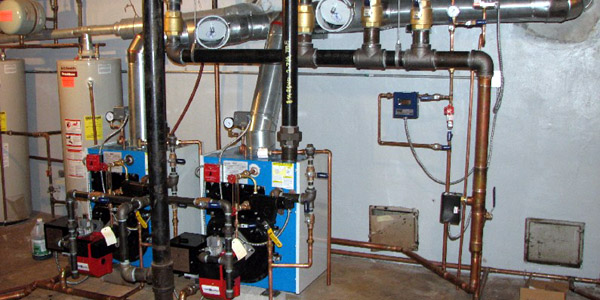
We have been replacing steam boilers on Long Island since 1979 and understand the specific challenges these systems present. Every steam boiler replacement we perform begins with a complete radiation survey, where we measure each radiator in your home to calculate the exact steam output required. This is the single most important step in a steam boiler project, and it is a step that many general HVAC contractors skip or perform incorrectly.
Steam systems distribute heat by generating steam in the boiler, which rises through pipes to radiators throughout your home. As the steam releases its heat energy, it condenses back into water and returns to the boiler to be reheated. This cycle requires careful balance between boiler output, pipe sizing, air vents, and condensate return. A properly sized and installed steam boiler provides comfortable, even heat with minimal noise and maximum efficiency.
Understanding which type of steam system you have is essential for proper boiler selection and replacement. Each operates differently and has distinct requirements.
| Feature | One-Pipe Steam | Two-Pipe Steam |
|---|---|---|
| How It Works | Steam and condensate share the same pipe | Steam travels up one pipe, condensate returns down a separate pipe |
| Prevalence on LI | Most common in pre-1950 homes | Common in larger pre-war homes and multi-family |
| Radiator Valves | One valve per radiator (on/off only) | Two valves per radiator (supply and return) |
| Air Vents | Required on every radiator and main lines | Thermostatic traps on each radiator |
| Zoning Capability | Limited (main vents can help balance) | Better zoning with thermostatic traps |
| Typical Issues | Water hammer, uneven heating, vent failures | Failed traps, condensate backup, uneven heat |
| Replacement Cost | $7,990 – $9,900 | $8,600 – $10,600 |
The most common steam issue on Long Island is a one-pipe system with failing air vents and an oversized boiler. When air vents malfunction, radiators heat unevenly because air cannot escape fast enough for steam to fill each radiator. We address these issues as part of every steam boiler replacement, replacing worn vents and ensuring proper balance across the system.
The number one error in steam boiler replacement is incorrect sizing. Many contractors size a steam boiler using the same heat loss calculation method used for hot water boilers. This is wrong for steam systems.
A steam boiler must be sized to match the connected radiation, not the heat loss of the building. This means measuring every radiator, every convector, and every linear foot of baseboard in the home and calculating the total square feet of steam (also called EDR, or Equivalent Direct Radiation). The boiler must produce enough steam to fill all of this radiation simultaneously.
An oversized steam boiler short-cycles, wastes fuel, and causes uneven heating. An undersized steam boiler cannot fill all the radiation, leaving rooms cold. Either mistake leads to discomfort and higher energy bills.
| Feature | Cast Iron | Steel (Fire-Tube) |
|---|---|---|
| Construction | Assembled from individual cast iron sections | Welded steel shell with fire tubes |
| Lifespan | 25 – 40+ years | 15 – 25 years |
| Weight | Heavy (often 500 – 1,000+ lbs) | Lighter (easier basement access) |
| Corrosion Resistance | Excellent with proper water treatment | Good, but more vulnerable to oxygen corrosion |
| Repair | Individual sections can be replaced | Difficult to repair; often requires full replacement |
| Efficiency (AFUE) | 80 – 85% | 80 – 84% |
| Installed Cost | $8,500 – $9,900 | $8,000 – $9,000 |
| Best For | Long-term investment. Maximum lifespan. | Budget-conscious. Tight basement access. |
We recommend cast iron steam boilers for most Long Island homes because of their superior longevity and resistance to the corrosive conditions inherent in steam systems. Cast iron sections can be carried down narrow basement stairs individually and assembled on site, which is important for older Long Island homes with limited access. For a broader comparison of all boiler types, see our boiler types comparison guide.
| Brand | Installed Price | AFUE | Highlights |
|---|---|---|---|
| Weil-McLain | $8,900 – $9,990 | 82 – 84% | EG and PEG series. Cast iron. The industry standard for residential steam on LI. |
| Burnham | $8,500 – $9,990 | 82 – 84% | IN and Series 2 steam models. Cast iron. Wide range of sizes. |
| Peerless | $8,400 – $9,000 | 81 – 83% | ECT and 63/64 series. Cast iron. Value-priced. Reliable. |
| Williamson | $8,300 – $9,290 | 82 – 84% | GSA series (gas) and GWA series (oil). Strong steam lineup. |
| New Yorker | $8,600 – $9,890 | 82 – 84% | CL and CGS series. Cast iron. American-made. Solid steam option. |
| Buderus | $8,500 – $9,200 | 84 – 85% | G215 series. German-engineered cast iron. Premium tier. |
| PurePro Advantage | $8,200 – $9,190 | 82% | AGS series. Cast iron. Installer-ready with step-open gas valve and low water cutoff. 10-year heat exchanger warranty. |
All prices shown are equipment only. Total installed cost depends on the model, number of sections, fuel type, and installation complexity. For a full cost breakdown, see our boiler replacement cost guide.
We measure every radiator and convector to calculate your exact EDR and select the correct boiler size.
Complete disconnection, draining, and removal of the existing steam boiler from your basement.
Properly sized headers, risers, equalizer, and Hartford Loop per manufacturer specifications.
Required mechanical permit and post-installation building department inspection.
Installation of a probe-type or float-type LWCO for safe boiler operation.
Combustion analysis, pressure testing, zone verification, and homeowner walkthrough.
The piping immediately around the steam boiler is just as important as the boiler itself. Improperly sized or configured near-boiler piping is one of the leading causes of water hammer, wet steam, and uneven heating in steam systems on Long Island.
Every steam boiler manufacturer publishes specific piping diagrams that must be followed exactly. The header pipe, equalizer, and Hartford Loop must be sized correctly for the boiler output. Cutting corners on near-boiler piping will undermine the performance of even the best steam boiler. We follow manufacturer piping specifications on every installation.
Many homeowners with steam systems wonder whether they should convert to hot water when replacing their boiler. Here is a brief comparison to help evaluate that decision.
| Feature | Steam System | Hot Water System |
|---|---|---|
| Distribution | Steam rises by pressure (no pump needed) | Circulator pumps push water through piping |
| Efficiency | 80 – 85% AFUE (standard) | 80 – 98% AFUE (condensing available) |
| Zoning | Limited | Excellent with multiple zone valves |
| Noise | Clanking, hissing, water hammer possible | Very quiet |
| Conversion Cost | $15,000 – $30,000+ (new piping throughout home) | |
Converting a steam system to hot water requires replacing all the piping in your home, which is extremely expensive and disruptive. In most cases, replacing the steam boiler with a new, properly sized steam unit is the more practical and cost-effective choice. For homeowners who want to move away from steam entirely, a heat pump conversion or furnace conversion may be worth exploring if ductwork is feasible.
Cast iron steam boilers can last 25 to 40 years with proper maintenance, but efficiency declines with age. Signs that replacement is approaching include visible cracks or leaks in the cast iron sections, a cracked or deteriorating combustion chamber, rust-colored water in the gauge glass, repair costs exceeding $1,500 in a single year, difficulty maintaining consistent steam pressure, and a boiler age of 25 years or more with declining performance. For a detailed guide, see 10 signs it is time to replace your boiler or use our repair vs. replace decision guide.
Every steam boiler replacement begins with a free in-home assessment and radiation survey. We measure your radiators, inspect the existing boiler and piping, identify any system issues, and provide a detailed written estimate. Call (631) 860-6681 or schedule online.
Steam boiler replacement requires specialized expertise. Schedule a free in-home assessment with a complete radiation survey and detailed written estimate.